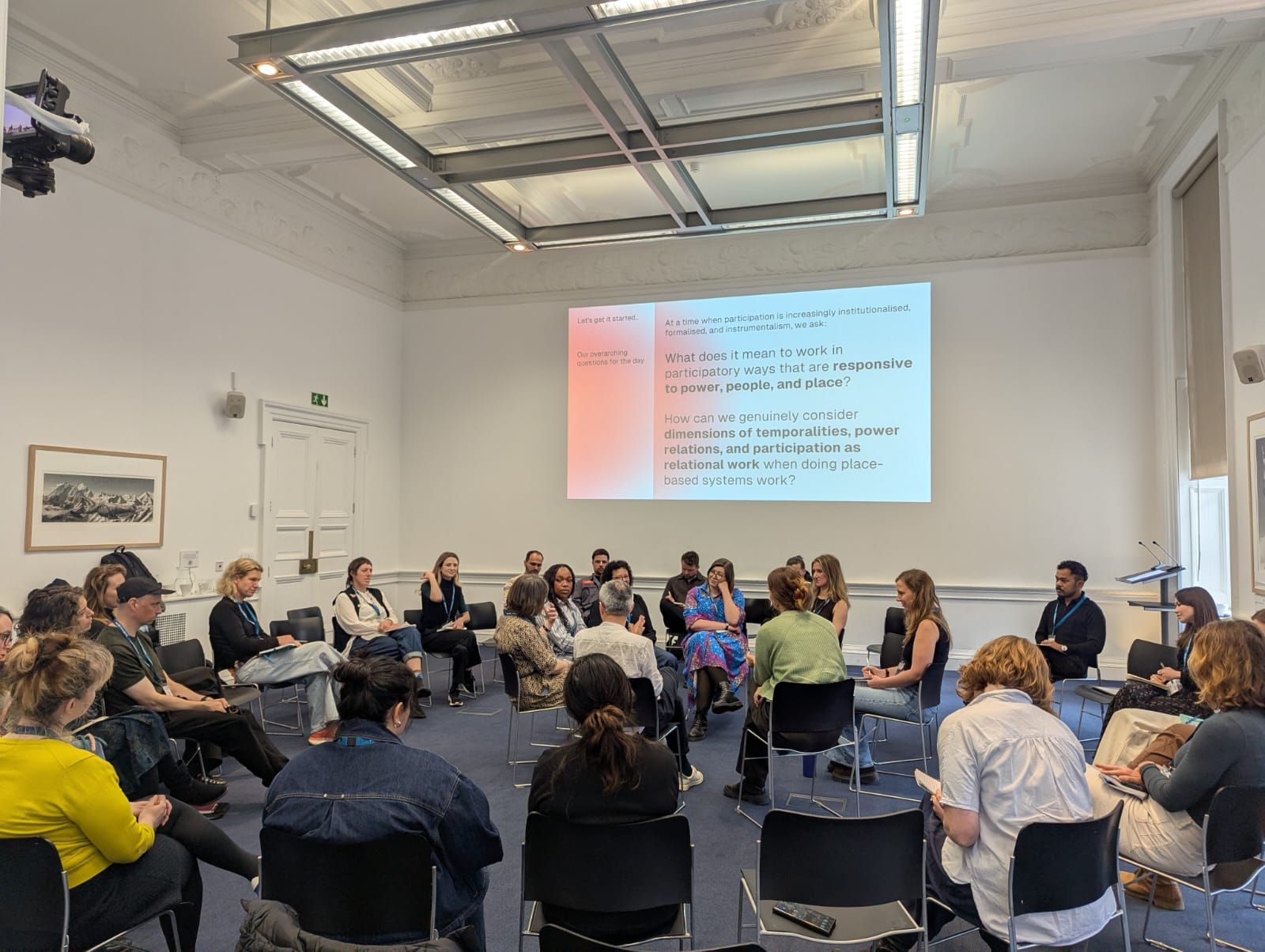
On April 17th, 2026, Alice Lawrence and I organised ‘Place-based Systems Change: Re-situating Participatory Practice’ hosted at the Royal Geographical Society (with IBG) in London, alongside the Participatory Geographies Research Group – and the energy was contagious!
✨
After beginning the day with getting into relation with one another, we went into provocations from our four invited speakers:
Indy Johar (Dark Matter Labs) challenged us to broaden our definition of place beyond the local, framing it instead as an entangled network of planetary risk. Drawing connections from heat stress in UK cities to water insecurity in the Himalayas, he illustrated how volatility across water, energy, and financial systems can cascade across places, urging us not to see place as fixed or bounded.
Dr. Camilla Buchanan (Policy Lab UK) reflected on the work of embedding a plethora of participatory methods—such as film ethnography and collective intelligence—across different agencies within UK Government to inform policy design, decision-making, and for scaling policy.
Lisa Clarke (PG Collective) drew on her experience as a practitioner and funder at The Lankellychase Foundation to reflect on how differing experiences of time shape our ability to nurture meaningful relationships. She posed a series of questions for place-based practice: where does change feel slow, where does it feel fast, and what is our own skin in the game?
Charlotte Boddy (University of Oxford) discussed her research with Natural Resources Wales, emphasising that systems change is often driven by small, incremental, and largely unseen relational work. Her reflections highlighted the significance of individual agency—and in particular, the labour of ‘street level bureaucrats’ —in shaping meaningful change within, and sometimes despite, institutional systems.
We finished the morning session with a participatory fishbowl session – which was honestly a highlight for me! When organising this, we wanted to flip the narrative around traditional Q+As, moving away from a small group answering questions from the room to a more dialogic, participant‑led exchange. This format created space for insights to emerge from the collective rather than being driven by a single voice or panel.
After lunch, we held a collective inquiry session, with participants were able to go deeper into their own participatory practice and reflect on their own practice collectivly. To finish the day, we held a zine‑making workshop, where participants could creatively reflect on the ideas, discussions, and questions that had emerged throughout the sessions.
It was great to bring together policymakers, practitioners, and academics from across the systems thinking space to reflect on these emerging issues. Attendees rated the event highly (median 10/10 – avg. 9.14), with one noting the strength of the balance between provocation, conversation, and creative thinking.
Post by Tatiana Bodnar